KMeans
KMeans is machine-learning algorithm (NP-hard), popularly employed for cluster analysis in data mining, and interesting for benchmarking and performance evaluation.
The objective of the KMeans algorithm to group a set of multidimensional points into a predefined number of clusters, in which each point belongs to the closest cluster (with the nearest mean distance), in an iterative process.
tasks_kmeans.R# Copyright (c) 2025- King Abdullah University of Science and Technology,
# All rights reserved.
# RCOMPSs is a software package, provided by King Abdullah University of Science and Technology (KAUST) - STSDS Group.
# @file tasks_kmeans.R
# @brief This file contains the tasks of the K-means clustering application
# @version 1.0
# @author Xiran Zhang
# @date 2025-04-28
DEBUG <- list(
partial_sum = FALSE,
merge = FALSE,
converged = FALSE,
recompute_centres = FALSE,
kmeans_frag = FALSE
)
fill_fragment <- function(params_fill_fragment){
centres <- params_fill_fragment[[1]]
n <- params_fill_fragment[[2]]
mode <- params_fill_fragment[[3]]
# Obtain necessary numbers
ncluster <- nrow(centres)
dim <- ncol(centres)
# Random generation distributions
rand <- list(
"normal" = function(k) rnorm(k, mean = 0, sd = 0.05),
"uniform" = function(k) runif(k, 0, 0.1)
)
# Initialize the random points
frag <- matrix(rand[[mode]](n * dim), nrow = n, ncol = dim)
# Assign to different groups
group_ind <- sample(1:ncluster, n, replace = TRUE)
frag <- frag + centres[group_ind, ]
return(frag)
}
partial_sum <- function(fragment, centres) {
# Get necessary parameters
ncl <- nrow(centres)
if(ncol(fragment) != ncol(centres)) {
stop("fragment and centres must have the same number of columns\nNow fragment has <", ncol(fragment), "> columns and centres has <", ncol(centres), "> columns\n", sep = "")
}else{
dimension <- ncol(fragment)
}
if(DEBUG$partial_sum) {
cat("Doing partial sum\n")
cat("nrow(centres) =", nrow(centres), "\n")
cat(paste0("dimension = ", dimension, "\n"))
cat(paste0("typeof(fragment) = ", typeof(fragment), "; ", "typeof(centres) = ", typeof(centres), "\n"))
cat("fragment:\n")
#print(fragment)
cat("centres:\n")
print(centres)
}
partials <- matrix(nrow = ncl, ncol = dimension + 1)
if(DEBUG$partial_sum) {
cat("partials in partial_sum after initialization (should be full of NAs)\n")
print(partials)
}
close_centres <- apply(proxy::dist(fragment, centres, method = "euclidean"), 1, which.min)
if(DEBUG$partial_sum) {
cat("close_centres\n")
print(close_centres)
}
for (center_idx in 1:ncl) {
if(DEBUG$partial_sum) {
cat("center_idx =", center_idx, "\n")
}
indices <- which(close_centres == center_idx)
if(DEBUG$partial_sum) {
cat("indices:", indices, "\n")
cat("fragment[indices, ]\n")
print(fragment[indices, ])
}
# Check if there is any empty cluster
if(length(indices) == 0){
partials[center_idx,] <- 0
}else if(length(indices) == 1){
partials[center_idx, 1:dimension] <- fragment[indices, ]
partials[center_idx, dimension + 1] <- 1
}else{
if(DEBUG$partial_sum) {
cat("colSums:", "\n")
print(colSums(fragment[indices, ]))
cat("length(indices):", "\n")
print(length(indices))
}
partials[center_idx, 1:dimension] <- colSums(fragment[indices, ])
partials[center_idx, dimension + 1] <- length(indices)
}
}
if(DEBUG$partial_sum) {
cat("partials in partial_sum after computation\n")
print(partials)
}
return(partials)
}
merge2 <- function(partial1, partial2) {
if(DEBUG$merge) {
cat("Doing merge2\n")
print(partial1)
print(partial2)
}
accum <- partial1 + partial2
if(DEBUG$merge) {
cat("accum\n")
print(accum)
}
return(accum)
}
merge <- function(...){
input <- list(...)
input_len <- length(input)
if(DEBUG$merge) {
cat("Doing merge\n")
for(i in 1:input_len){
cat("Input", i, "\n")
print(input[[i]])
}
}
if(input_len == 1){
return(input[[1]])
}else if(input_len >= 2){
accum <- input[[1]]
for(i in 2:input_len){
accum <- accum + input[[i]]
}
if(DEBUG$merge) {
cat("accum\n")
print(accum)
}
return(accum)
}else{
stop("Wrong input in `merge`!\n")
}
}
functions_kmeans.R# Copyright (c) 2025- King Abdullah University of Science and Technology,
# All rights reserved.
# RCOMPSs is a software package, provided by King Abdullah University of Science and Technology (KAUST) - STSDS Group.
# @file functions_kmeans.R
# @brief This file contains the functions for the K-means clustering application
# @version 1.0
# @author Xiran Zhang
# @date 2025-04-28
converged <- function(old_centres, centres, epsilon, iteration, max_iter) {
if(DEBUG$converged) {
cat("Doing converged\n")
}
if(is.null(old_centres)) {
return(FALSE)
}
dist <- sum(rowSums((centres - old_centres)^2))
if(dist < epsilon^2){
cat("Converged!\n")
End <- TRUE
}else if(iteration >= max_iter){
cat("Max iteration reached!\n")
End <- TRUE
}else{
End <- FALSE
}
return(End)
}
recompute_centres <- function(partials, old_centres, arity) {
if(DEBUG$recompute_centres){
cat("\n\n+++++++++++++++++++++++++++++++++++++++++++++++++++++++++\n")
cat("Doing recompute centres\n")
cat("partials:\n")
print(partials)
cat("old_centres:\n")
print(old_centres)
cat("arity:\n")
print(arity)
}
dimension <- ncol(old_centres)
centres <- old_centres
if(DEBUG$recompute_centres){
cat("length(partials) =", length(partials), "\n")
cat("arity =", arity, "\n\n")
}
while(length(partials) > arity) {
if(DEBUG$recompute_centres >= 2){
cat("\npartials in recompute_centres\n")
print(partials)
}
if(DEBUG$recompute_centres >= 1){
cat("length(partials) > arity\n")
}
partials_subset <- partials[1:arity]
if(DEBUG$recompute_centres >= 1){
cat("partials_subset\n")
print(partials_subset)
}
partials <- partials[(arity + 1):length(partials)]
if(use_RCOMPSs){
partials[[length(partials) + 1]] <- do.call(task.merge, partials_subset)
}else{
partials[[length(partials) + 1]] <- do.call(merge, partials_subset)
}
}
if(DEBUG$recompute_centres >= 1){
cat("length(partials) <= arity\n")
}
if(use_RCOMPSs){
partials <- do.call(task.merge, partials)
partials <- compss_wait_on(partials)
}else{
partials <- do.call(merge, partials)
}
# For empty clusters, we give a random new mean
cl0 <- which(partials[,3] == 0)
if(length(cl0) > 0){
centres[cl0,] <- matrix(runif(length(cl0) * dimension), nrow = length(cl0), ncol = dimension)
centres[-cl0,] <- partials[-cl0, 1:dimension] / partials[-cl0, dimension + 1]
}else{
centres <- partials[,1:dimension] / partials[,dimension + 1]
}
if(DEBUG$recompute_centres >= 2){
cat("\npartials in recompute_centres after merge\n")
print(partials)
cat("dimension =", dimension, "\n")
cat("\ncentres\n")
print(centres)
}
return(centres)
}
#' A fragment-based K-Means algorithm.
#'
#' Given a set of fragments, the desired number of clusters and the
#' maximum number of iterations, compute the optimal centres and the
#' index of the centre for each point.
#'
#' @param fragments Number of fragments
#' @param dimensions Number of dimensions
#' @param num_centres Number of centres
#' @param iterations Maximum number of iterations
#' @param seed Random seed
#' @param epsilon Epsilon (convergence distance)
#' @param arity Reduction arity
#' @return Final centres
kmeans_frag <- function(fragment_list, num_centres = 10, iterations = 20, epsilon = 1e-9, arity = 50) {
# Centres is usually a very small matrix, so it is affordable to have it in
# the master.
centres <- matrix(runif(num_centres * dimensions), nrow = num_centres, ncol = dimensions)
if(DEBUG$kmeans_frag){
cat("Initialized centres:\n")
print(centres)
}
old_centres <- NULL
iteration <- 0
# Necessary parameters
dimensions <- ncol(fragment_list[[1]]) - 1 # dimensions of the data
num_frag <- length(fragment_list) # number of fragments in total
while (!converged(old_centres, centres, epsilon, iteration, iterations)) {
cat(paste0("Doing iteration #", iteration + 1, "/", iterations, ". "))
iteration_time <- proc.time()[3]
old_centres <- centres
if(use_RCOMPSs && use_merge2){
partials_accum <- matrix(0, nrow = nrow(centres), ncol = dimensions + 1)
for(i in 1:num_frag){
partials <- task.partial_sum(fragment = fragment_list[[i]], old_centres)
partials_accum <- task.merge2(partials_accum, partials)
}
partials_accum <- compss_wait_on(partials_accum)
if(DEBUG$kmeans_frag){
cat("use_RCOMPSs = TRUE; use_merge2 = TRUE\n")
cat("partials_accum:\n")
print(partials_accum)
}
centres <- partials_accum[,1:dimensions] / partials_accum[,dimensions + 1]
}else{
partials <- list()
if(use_RCOMPSs){
if(DEBUG$kmeans_frag){
cat("use_RCOMPSs = TRUE; use_merge2 = FALSE\n")
}
for(i in 1:num_frag){
partials[[i]] <- task.partial_sum(fragment = fragment_list[[i]], old_centres)
}
}else{
for(i in 1:num_frag){
partials[[i]] <- partial_sum(fragment = fragment_list[[i]], old_centres)
}
if(DEBUG$kmeans_frag){
cat("use_RCOMPSs = FALSE; use_merge2 = FALSE\n")
cat("partials in kmeans_frag:\n")
print(partials)
}
}
centres <- recompute_centres(partials, old_centres, arity)
}
iteration <- iteration + 1
if(DEBUG$kmeans_frag){
cat("centres:\n")
print(centres)
}
iteration_time <- proc.time()[3] - iteration_time
cat(paste0("Iteration time: ", round(iteration_time, 3), "\n"))
}
return(centres)
}
#' generate_points
#'
#' Generate points
#'
#' @param points Number of points
#' @param dim Number of dimensions
#' @param mode Dataset generation mode
#' @param seed Random seed
#' @param num_of_centres Number of clusters
#' @return Dataset fragment
generate_points <- function(points, dim, mode, seed, num_of_centres = 2) {
# Random generation distributions
rand <- list(
"normal" = function(k, x) rnorm(k, mean = x, sd = 0.05),
"uniform" = function(k, x) runif(k, x - 0.1, x + 0.1)
)
# Set the random seed
set.seed(seed)
# Generate the random fragment
cluster_centres <- matrix(runif(num_of_centres * dim), ncol = dim)
# plot(cluster_centres, col = "red")
num_of_points_cluster <- points %/% num_of_centres
mat <- matrix(0, nrow = points, ncol = dim + 1)
for(i in 1:(num_of_centres - 1)){
for(j in 1:dim){
mat[((i-1) * num_of_points_cluster + 1):(num_of_points_cluster * i), j] <- rand[[mode]](num_of_points_cluster, cluster_centres[i,j])
}
mat[((i-1) * num_of_points_cluster + 1):(num_of_points_cluster * i), dim + 1] <- i
}
rest_of_points <- points - num_of_points_cluster * (num_of_centres - 1)
# cat("points =", points, "\n")
# cat("num_of_points_cluster =", num_of_points_cluster, "\n")
# cat("rest_of_points =", rest_of_points, "\n")
for(j in 1:dim){
mat[(points - rest_of_points + 1):points, j] <- rand[[mode]](rest_of_points, cluster_centres[num_of_centres, j])
mat[(points - rest_of_points + 1):points, dim + 1] <- num_of_centres
}
# at <- matrix(rand[[mode]](dim * points), ncol = dim)
# Normalize all points between 0 and 1
mat[,1:2] <- apply(mat[,1:2], 2, function(x) (x - min(x)) / (max(x) - min(x)))
return(mat)
}
parse_arguments <- function(Minimize) {
if(!Minimize){
cat("Starting parse_arguments\n")
}
args <- commandArgs(trailingOnly = TRUE)
# Define default values
# Note that if `num_fragments` is not a factor of `numpoints`, the last fragment may give NA due to lack of points.
seed <- 1
numpoints <- 100
dimensions <- 2
num_centres <- 5
fragments <- 10
mode <- "uniform"
iterations <- 20
epsilon <- 1e-9
arity <- 5
# Execution using RCOMPSs
use_RCOMPSs <- FALSE
# Execution using default R function
use_R_default <- FALSE
# asking for help
is.asking_for_help <- FALSE
# plot?
needs_plot <- TRUE
# Parse arguments
if(length(args) >= 1){
for (i in 1:length(args)) {
if (args[i] == "-s") {
seed <- as.integer(args[i + 1])
} else if (args[i] == "--seed") {
seed <- as.integer(args[i + 1])
} else if (args[i] == "-n") {
numpoints <- as.integer(args[i + 1])
} else if (args[i] == "--numpoints") {
numpoints <- as.integer(args[i + 1])
} else if (args[i] == "-d") {
dimensions <- as.integer(args[i + 1])
} else if (args[i] == "--dimensions") {
dimensions <- as.integer(args[i + 1])
} else if (args[i] == "-c") {
num_centres <- as.integer(args[i + 1])
} else if (args[i] == "--num_centres") {
num_centres <- as.integer(args[i + 1])
} else if (args[i] == "-f") {
fragments <- as.integer(args[i + 1])
} else if (args[i] == "--fragments") {
fragments <- as.integer(args[i + 1])
} else if (args[i] == "-m") {
mode <- args[i + 1]
} else if (args[i] == "--mode") {
mode <- args[i + 1]
} else if (args[i] == "-i") {
iterations <- as.integer(args[i + 1])
} else if (args[i] == "--iterations") {
iterations <- as.integer(args[i + 1])
} else if (args[i] == "-e") {
epsilon <- as.double(args[i + 1])
} else if (args[i] == "--epsilon") {
epsilon <- as.double(args[i + 1])
} else if (args[i] == "-a") {
arity <- as.integer(args[i + 1])
} else if (args[i] == "--arity") {
arity <- as.integer(args[i + 1])
} else if (args[i] == "-p") {
needs_plot <- as.logical(args[i + 1])
} else if (args[i] == "--plot") {
needs_plot <- as.logical(args[i + 1])
} else if (args[i] == "-C") {
use_RCOMPSs <- TRUE
} else if (args[i] == "--RCOMPSs") {
use_RCOMPSs <- TRUE
} else if (args[i] == "-R") {
use_R_default <- TRUE
} else if (args[i] == "--R-default") {
use_R_default <- FALSE
} else if (args[i] == "-h") {
is.asking_for_help <- TRUE
} else if (args[i] == "--help") {
is.asking_for_help <- TRUE
}
}
}
if(is.asking_for_help){
cat("Usage: Rscript kmeans.R [options]\n")
cat("Options:\n")
cat(" -s, --seed <seed> Seed for random number generator\n")
cat(" -n, --numpoints <numpoints> Number of points\n")
cat(" -d, --dimensions <dimensions> Number of dimensions\n")
cat(" -c, --num_centres <num_centres> Number of centers\n")
cat(" -f, --fragments <fragments> Number of fragments\n")
cat(" -m, --mode <mode> Mode for generating points\n")
cat(" -i, --iterations <iterations> Maximum number of iterations\n")
cat(" -e, --epsilon <epsilon> Epsilon (convergence distance)\n")
cat(" -a, --arity <arity> Reduction arity\n")
cat(" -p, --plot <needs_plot> Boolean: Plot?\n")
cat(" -C, --RCOMPSs <use_RCOMPSs> Boolean: Use RCOMPSs parallelization?\n")
cat(" -M, --Minimize <Minimize> Boolean: Minimize printout?\n")
cat(" -h, --help Show this help message\n")
q(status = 0)
}
if(numpoints %% fragments){
stop("Number of fragment is not a factor of number of points!\n")
}
if(use_RCOMPSs && use_R_default){
stop("Default R function `kmeans` cannot run with RCOMPSs\n")
}
return(list(
seed = seed,
numpoints = numpoints,
dimensions = dimensions,
num_centres = num_centres,
num_fragments = fragments,
mode = mode,
iterations = iterations,
epsilon = epsilon,
arity = arity,
needs_plot = needs_plot,
use_RCOMPSs = use_RCOMPSs,
use_R_default = use_R_default
))
}
print_parameters <- function(params) {
cat("Parameters:\n")
cat(sprintf(" Seed: %d\n", params$seed))
cat(sprintf(" Number of points: %d\n", params$numpoints))
cat(sprintf(" Dimensions: %d\n", params$dimensions))
cat(sprintf(" Number of centers: %d\n", params$num_centres))
cat(sprintf(" Number of fragments: %d\n", params$num_fragments))
cat(sprintf(" Mode: %s\n", params$mode))
cat(sprintf(" Iterations: %d\n", params$iterations))
cat(sprintf(" Epsilon: %.e\n", params$epsilon))
cat(sprintf(" Arity: %d\n", params$arity))
cat(" needs_plot:", params$needs_plot, "\n")
cat(" use_RCOMPSs:", params$use_RCOMPSs, "\n")
cat(" use_R_default:", params$use_R_default, "\n")
}
kmeans.R# Copyright (c) 2025- King Abdullah University of Science and Technology,
# All rights reserved.
# RCOMPSs is a software package, provided by King Abdullah University of Science and Technology (KAUST) - STSDS Group.
# @file kmeans.R
# @brief This file contains the main application of K-means clustering
# @version 1.0
# @author Xiran Zhang
# @date 2025-04-28
flush.console()
Sys.sleep(1)
args <- commandArgs(trailingOnly = TRUE)
use_merge2 <- FALSE
Minimize <- FALSE
# Parse arguments
if(length(args) >= 1){
for (i in 1:length(args)) {
if (args[i] == "-M") {
Minimize <- TRUE
} else if (args[i] == "--Minimize") {
Minimize <- TRUE
}
}
}
# Source necessary functions
if(!Minimize){
cat("Sourcing necessary functions ... ")
}
source("tasks_kmeans.R")
source("functions_kmeans.R")
if(!Minimize){
cat("Done.\n")
}
if(!Minimize){
cat("Getting parameters ... ")
}
params <- parse_arguments(Minimize)
if(!Minimize){
print_parameters(params)
}
attach(params)
if(!Minimize){
cat("Done.\n")
}
set.seed(seed)
if(use_RCOMPSs){
require(RCOMPSs)
# Initiate COMPSs
if(!Minimize){
cat("Starting COMPSs ... ")
}
compss_start()
cat("COMPSs started!\n")
flush.console()
if(!Minimize){
cat("Done.\n")
}
# Define the tasks
if(!Minimize){
cat("Defining the tasks ... ")
}
task.fill_fragment <- task(fill_fragment, "tasks_kmeans.R", info_only = FALSE, return_value = TRUE, DEBUG = FALSE)
task.partial_sum <- task(partial_sum, "tasks_kmeans.R", info_only = FALSE, return_value = TRUE, DEBUG = FALSE)
task.merge <- task(merge, "tasks_kmeans.R", info_only = FALSE, return_value = TRUE, DEBUG = FALSE)
task.merge2 <- task(merge2, "tasks_kmeans.R", info_only = FALSE, return_value = TRUE, DEBUG = FALSE)
if(!Minimize){
cat("Done.\n")
}
}else{
if(!Minimize){
cat("Sequential execution without RCOMPSs!\n")
}
}
# Look at the kmeans_frag for the KMeans function.
# This code is used for experimental purposes.
# I.e it generates random data from some parameters that determine the size,
# dimensionality and etc and returns the elapsed time.
for(replicate in 1:1){
start_time <- proc.time()
# Generate the data
if(!Minimize){
cat("Generating data replicate", replicate, "... ")
}
# Prevent infinite loops
points_per_fragment <- max(1, numpoints %/% num_fragments)
# Generate cluster central points
true_centres <- matrix(runif(num_centres * dimensions),
nrow = num_centres, ncol = dimensions)
fragment_list <- list()
if(use_RCOMPSs){
for (f in 1:num_fragments) {
params_fill_fragment <- list(true_centres, points_per_fragment, mode)
fragment_list[[f]] <- task.fill_fragment(params_fill_fragment)
}
#fragment_list <- compss_wait_on(fragment_list)
}else{
for (f in 1:num_fragments) {
params_fill_fragment <- list(true_centres, points_per_fragment, mode)
fragment_list[[f]] <- fill_fragment(params_fill_fragment)
}
}
initialization_time <- proc.time()
if(!Minimize){
cat("Done.\n")
}
#print(fragment_mat)
# Run kmeans
if(use_R_default){
fragment_mat <- do.call(rbind, fragment_list)
centres <- kmeans(fragment_mat[, 1:dimensions], num_centres, iterations)
}else{
centres <- kmeans_frag(
fragment_list = fragment_list,
num_centres = num_centres,
iterations = iterations,
epsilon = epsilon,
arity = arity
)
}
kmeans_time <- proc.time()
Initialization_time <- initialization_time[3] - start_time[3]
Kmeans_time <- kmeans_time[3] - initialization_time[3]
Total_time <- proc.time()[3] - start_time[3]
if(!Minimize){
cat("-----------------------------------------\n")
cat("-------------- RESULTS ------------------\n")
cat("-----------------------------------------\n")
cat("Initialization time:", Initialization_time, "seconds\n")
cat("Kmeans time:", Kmeans_time, "seconds\n")
cat("Total time:", Total_time, "seconds\n")
cat("-----------------------------------------\n")
# Sort the results and compare
ind_centres <- sort(centres[,1], index.return = TRUE)$ix
ind_true_centres <- sort(true_centres[,1], index.return = TRUE)$ix
cat("CENTRES\n")
print(centres[ind_centres,])
cat("TRUE CENTRES\n")
print(true_centres[ind_true_centres,])
cat("-----------------------------------------\n")
}
if(use_R_default){
type <- "R_default"
}else if(use_RCOMPSs){
type <- "RCOMPSs"
}else{
type <- "R_sequential"
}
if(Minimize){
cat("KMEANS_RESULTS,",
seed, ",",
numpoints, ",",
dimensions, ",",
num_centres, ",",
num_fragments, ",",
mode, ",",
iterations, ",",
epsilon, ",",
arity, ",",
type, ",",
paste(R.version$major, R.version$minor, sep="."), ",",
Initialization_time, ",",
Kmeans_time, ",",
Total_time, ",",
replicate,
"\n", sep = ""
)
}
}
if(use_RCOMPSs){
if(needs_plot) fragment_list <- compss_wait_on(fragment_list)
compss_stop()
}
# Plot the data
if(needs_plot){
pdf(paste0("kmeans", Sys.time(), ".pdf"))
par(bg = "white")
fragment_mat <- do.call(rbind, fragment_list)
plot(fragment_mat, col = "blue", xlab = "x", ylab = "y")
points(centres, col = "red", pch = 8)
dev.off()
}
The kmeans application can be executed by invoking the runcompss command
with the desired parameters (in this case we use -g to generate the
task dependency graph) and application.
The following lines provide an example of its execution considering 10M points,
of 3 dimensions, divided into 8 fragments, looking for 8 clusters and a maximum
number of iterations set to 10.
compss@bsc:~$ runcompss --lang=r -g kmeans.R --seed 1 --numpoints 10240000 --dimensions 3 --num_centres 8 --fragments 8 --mode "normal" --iterations 10 --epsilon 1e-9 --arity 2 --plot FALSE --RCOMPSs --Minimize
[ INFO ] Using default location for project file: /opt/COMPSs//Runtime/configuration/xml/projects/default_project.xml
[ INFO ] Using default location for resources file: /opt/COMPSs//Runtime/configuration/xml/resources/default_resources.xml
[ INFO ] Using default execution type: compss

----------------- Executing kmeans.R --------------------------

Welcome to Extrae 3.8.3
[(1352)    API]  -  Starting COMPSs Runtime v3.4 (build 20250513-0839.rfcc8f551ada00b095448810eee6b34a1baca40f8)
COMPSs started!
Doing iteration #1/10. Iteration time: 44,889
Doing iteration #2/10. Iteration time: 32,095
Doing iteration #3/10. Iteration time: 35,113
Doing iteration #4/10. Iteration time: 33,972
Doing iteration #5/10. Iteration time: 46,918
Doing iteration #6/10. Iteration time: 42,38
Doing iteration #7/10. Iteration time: 40,026
Doing iteration #8/10. Iteration time: 35,001
Doing iteration #9/10. Iteration time: 34,133
Doing iteration #10/10. Iteration time: 32,708
Max iteration reached!
KMEANS_RESULTS,1,10240000,3,8,8,normal,10,1e-09,2,RCOMPSs,3.6.3,0,05,377,302,377,352,1
[(385289)    API]  -  Execution Finished

------------------------------------------------------------
Figure 86 depicts the generated task dependency graph. The dataset generation can be identified in the 8 blue tasks, while the five iterations appear next. Between the iteration there is a synchronization which corresponds to the convergence/max iterations check.
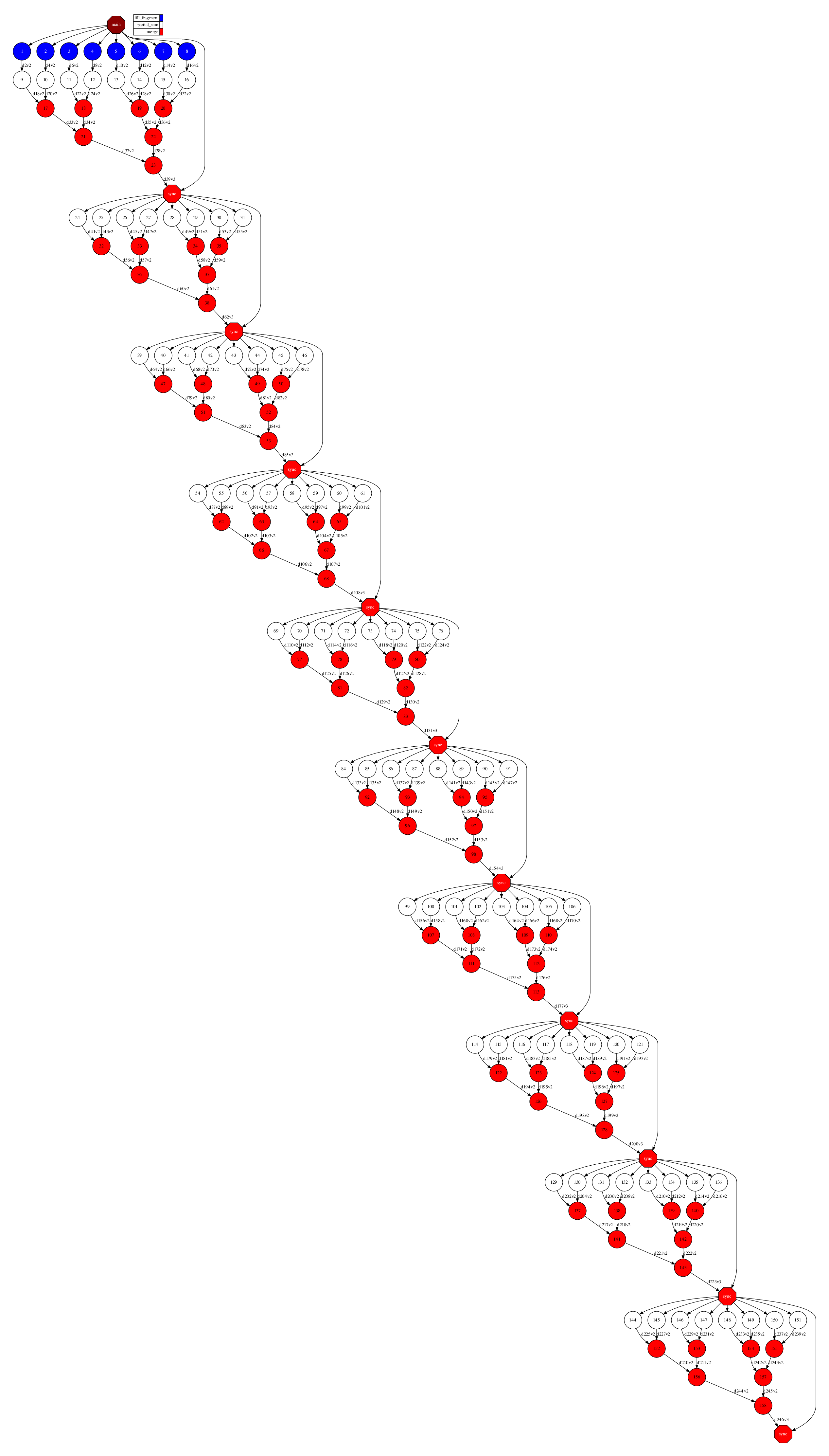
Figure 86 R kmeans tasks graph